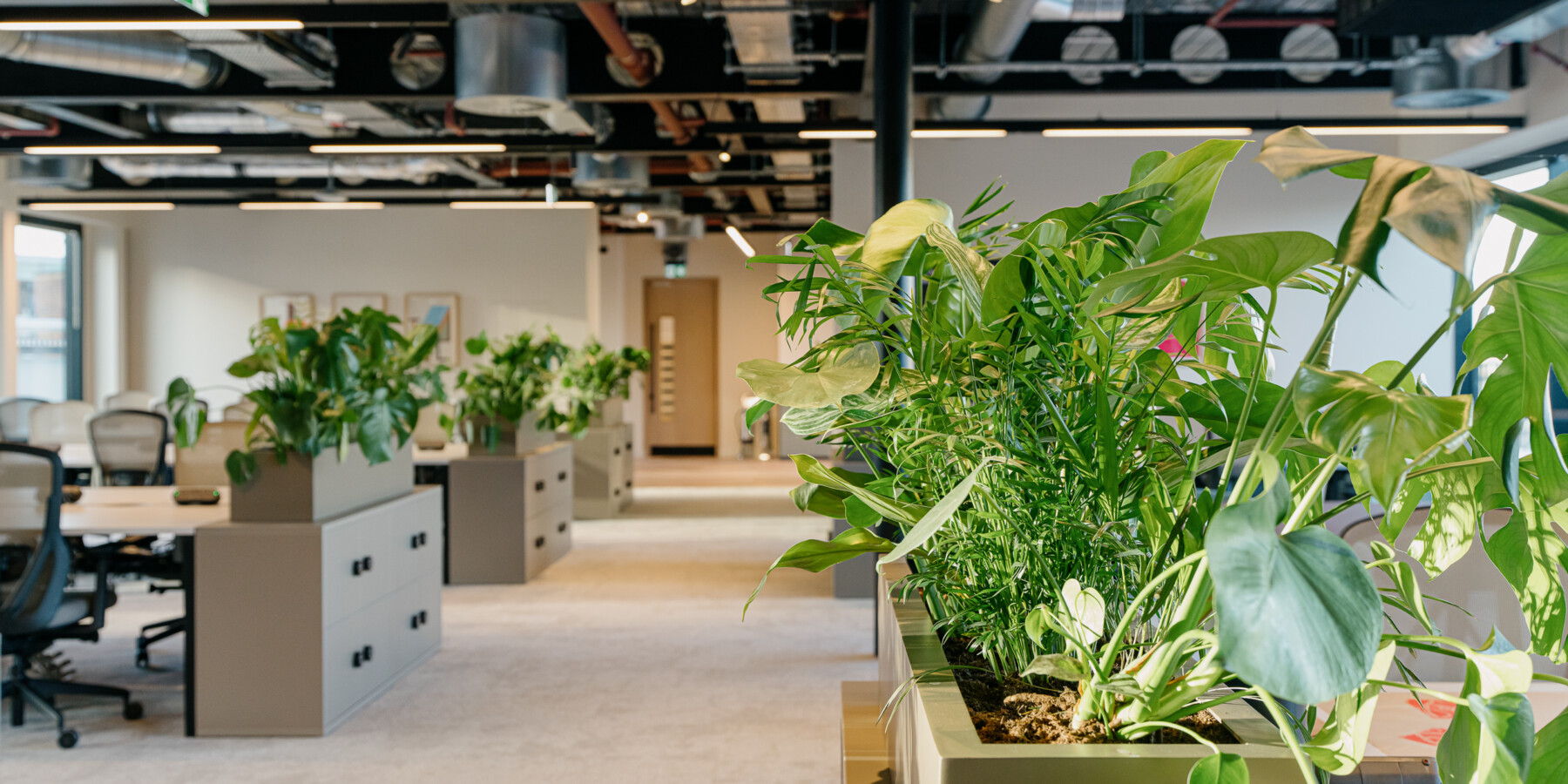
What Indoor Plants Actually Do to the Air You Breathe at Work
Most of us give very little thought to the air in our offices. We open a window in summer, complain when the air conditioning is too cold, and assume the rest is fine. It probably isn’t.
90%
of our time spent indoors (UK estimates)
Up to 10×
higher VOC concentrations indoors vs. outdoors
4 million
deaths worldwide annually linked to indoor air pollution
According to a 2023 Parliamentary Office of Science and Technology briefing on indoor air quality, volatile organic compounds (VOCs) are consistently found at concentrations up to ten times higher indoors than outdoors. These aren’t exotic industrial pollutants. They come from the furniture people sit on, the carpets beneath their feet, the cleaning products used overnight, and the printers humming in the corner.
The question isn’t whether your office air is problematic. The more useful question is: what can you do about it? This piece looks at what the science actually says about plants and air quality, not the simplified version, but the full picture, and why, properly specified and properly placed, living plants and green walls are one of the most compelling tools available to anyone designing or managing a healthier workplace.
First: Why Is Office Air So Bad?
The modern office is, from an air quality perspective, a surprisingly complex environment. Since the energy crises of the 1970s, buildings have been progressively sealed and insulated to reduce heating and cooling costs. The same properties that make them energy efficient, tight windows, reduced air exchange, dense insulation, also allow airborne pollutants to accumulate.
The key culprits are VOCs, volatile organic compounds, a category that includes formaldehyde (released by pressed wood furniture, adhesives and insulation), benzene (from synthetic fibres, paints and cleaning products), trichloroethylene (from photocopiers and correction fluid), and xylene and toluene (from adhesives, rubber and leather).
These aren’t alarming at low individual doses, but in poorly ventilated buildings they accumulate over time. The result is the cluster of symptoms often grouped under the term ‘Sick Building Syndrome‘: headaches, fatigue, dry throat, difficulty concentrating, and respiratory irritation. According to DEFRA’s indoor air quality report, high indoor VOC concentrations are linked to increased risk of conditions ranging from eye and respiratory irritation to, in long-term high-level exposures, more serious health concerns.
Key Fact:
According to the UK Health Security Agency and the Parliamentary POST briefing (2023), indoor VOC concentrations are consistently higher indoors than outdoors, often by a factor of up to ten, primarily due to off-gassing from furniture, furnishings, building materials, and cleaning products.
The situation is made worse in winter, when ventilation rates drop further, people open windows less, air exchange slows, and occupants spend more time indoors. The RHS notes that VOC concentrations are typically at their highest during colder months precisely because the indoor environment becomes more sealed.
What Plants Actually Do — The Real Mechanism
In 1989, NASA scientist Dr Bill Wolverton published what became one of the most cited, and most misrepresented, studies in the history of indoor horticulture. The NASA Clean Air Study, conducted to find ways to purify air in sealed space stations, showed that certain common houseplants could measurably reduce concentrations of VOCs including formaldehyde, benzene and trichloroethylene in sealed test chambers.
The finding made headlines and planted, so to speak, an idea that has never quite left the public consciousness: that houseplants are natural air purifiers.
The nuance the headlines missed
Subsequent research has added important context. The conditions of the NASA study, sealed chambers, controlled pollutant concentrations, and high plant-to-volume ratios, don’t directly translate to a typical open-plan office. A 2019 review in the Journal of Exposure Science & Environmental Epidemiology concluded that you would need between 10 and 1,000 plants per square metre of floor space to match the VOC removal achieved by standard indoor-outdoor air exchange in a normal building.
That sounds discouraging, but it misses what is actually happening, and why it still matters for a workplace strategy.
The two mechanisms that do work
Plants affect indoor air through two distinct processes, both of which are real and measurable.
Stomatal absorption.
Leaves absorb VOCs through their stomata, the tiny pores that plants use to exchange gases during photosynthesis. Once inside the leaf, plant enzymes can break down or metabolise certain compounds. Research using radioactive carbon tracers (conducted at Germany’s GSF-National Research Center for Environment and Health) showed that the spider plant was able to directly break down formaldehyde into metabolic products, 90% of absorbed formaldehyde was converted into sugars and new plant material.
Root-zone microbiome.
This is the less-publicised and arguably more powerful mechanism. Plants draw air down through their root systems via transpiration, essentially using their water-pumping action to pull contaminated air into contact with the growing medium. The soil microorganisms living in the root zone then metabolise and neutralise VOC molecules. Wolverton’s own later research showed that actively circulating air through plant root systems could increase VOC removal rates by approximately 200-fold compared to passive leaf absorption alone.
Why this matters for green walls:
Professional green wall systems, as installed by Urban Planters, include growing media with densely populated root zones across large vertical areas — creating the conditions where root-zone bioremediation can operate at meaningful scale.
A 2020 review published in Facts Reports confirmed this: indoor plants were able to remove VOCs that were continuously off-gassed in closed systems, ‘thanks to the combined action of plant leaves and root microbes, by metabolisation, translocation and/or transpiration.’
Humidity, Carbon Dioxide, and the Broader Picture
VOC removal is only one dimension of the air quality story. Plants affect the indoor atmosphere in several other ways that are just as relevant to occupant comfort and cognitive performance.
Humidity regulation
Air-conditioned and heated offices in the UK regularly fall well below the 40–60% relative humidity range recommended by CIBSE for occupant comfort and health. At lower humidity levels, mucous membranes dry out, increasing susceptibility to respiratory viruses, and static electricity increases, causing discomfort and interfering with electronics. Plants release water vapour through transpiration, raising ambient humidity. Studies cited by the RHS have shown that plant-filled rooms can maintain humidity levels more consistently within healthy ranges than equivalent rooms without plants.
Carbon dioxide management
This is well-established science: plants absorb CO₂ during photosynthesis and release oxygen. In practical terms, elevated CO₂ levels in offices (above approximately 1,000 ppm, which is not uncommon in poorly ventilated meeting rooms) are associated with measurable reductions in cognitive performance and decision-making ability. CIBSE guidance on indoor air quality identifies CO₂ as one of the primary indicators of ventilation adequacy in non-domestic buildings. Plants contribute to maintaining lower CO₂ concentrations, particularly in spaces with limited fresh air supply.
Airborne particulates and microbiome effects
Research highlighted in the RHS’s houseplant health guidance indicates that plant-filled rooms contain fewer airborne bacteria and mould spores than equivalent unfurnished spaces. Plants appear to alter the composition of the indoor microbiome, the community of microorganisms present in the air, in ways that reduce the prevalence of potentially harmful species. The RHS also notes that houseplants can absorb nitrogen dioxide, a common indoor pollutant in buildings near busy roads.
The Part Everyone Undervalues: Air Quality and Cognitive Performance
The reason air quality matters most to a business isn’t primarily health and safety compliance. It’s performance. And the evidence connecting indoor air quality to cognitive output is now substantial.
TheRHS’s review of houseplant research found that indoor plants have been associated with reduced fatigue (by up to 20% in some workplace studies), improved concentration, and higher levels of reported wellbeing, all of which directly affect how effectively people work. A systematic review and meta-analysis published in IJERPH in 2022 (covering multiple randomised and quasi-experimental studies) concluded that people perform measurably better across a range of tasks in environments with indoor plants than in equivalent spaces without them, with statistically significant improvements in academic achievement and lower systolic blood pressure.
Importantly, the wellbeing effect doesn’t require people to consciously engage with plants. The RHS notes that simply viewing greenery, having it in one’s line of vision, appears to trigger measurable physiological responses including reduced heart rate, lower cortisol levels, and improved self-reported mood. The mechanism is thought to relate to what the biologist E.O. Wilson described as biophilia: the evolved human inclination to respond positively to natural environments.
The University of Reading and RHS also found that the appearance of plants matters; lush, full-canopied plants produced the greatest positive effect on perceived wellbeing and perceived air quality. This is directly relevant to the specification: a sparse or poorly maintained green wall does not deliver the same benefit as one that is professionally designed and regularly tended.
Putting It Into Practice: Which Plants Work Best
Not all plants are equal in terms of their air quality contribution. The NASA study and subsequent research identified significant differences between species. The following plants performed consistently well across multiple studies and are well-suited to UK office conditions:
Plant
Removes
Best Placement
Peace Lily (Spathiphyllum)
Benzene, formaldehyde, trichloroethylene, CO₂
Reception areas, meeting rooms — tolerates shade well
Mother-in-Law’s Tongue
Formaldehyde, benzene, xylene, toluene
Offices with limited natural light — low maintenance
English Ivy (Hedera helix)
Benzene, formaldehyde, xylene, toluene, trichloroethylene
Trailing from shelves or in green walls — versatile
Dracaena (various species)
Benzene, formaldehyde, xylene, toluene, trichloroethylene
Floor-standing specimen plants in open areas
Parlour Palm
All five major VOC groups tested by NASA
Meeting rooms, breakout areas — tropical aesthetic
Spider Plant
Formaldehyde (metabolised via leaf enzymes)
Hanging or wall-mounted — actively breaks down VOCs
Boston Fern
Formaldehyde — excellent humidity regulation
Areas prone to dry air from heating/AC
It is worth emphasising what the RHS also notes: soil-based growing media are significantly superior to hydroponics for VOC uptake, because the root-zone microbiome is more diverse and active in soil. This has direct implications for the specification of green wall systems.
Scale Is Everything: Why Green Walls Change the Equation
The honest answer to ‘can a few potted plants clean the air in my office?’ is: modestly, at best. But that’s not the right question. The right question is: what does meaningful plant coverage, properly specified, actually achieve?
A living green wall, whether fixed in a reception area or mobile within a workspace, brings together several hundred square centimetres of leaf surface area, active root-zone biology, and a continuous transpiration effect that potted plants simply cannot match at room scale. The cumulative effect on humidity, CO₂ levels, particulate counts, and VOC concentrations is proportionally greater, and the psychological and wellbeing benefits scale accordingly.
UKRI is currently funding a £600,000 multi-university research network (GREENIN, led by University of Surrey, Oxford, York, UKCEH, Bath and Cranfield) specifically to investigate how indoor plants can improve air quality, regulate temperature and control humidity at building scale. The fact that this level of institutional research interest exists is itself an indicator of the genuine scientific seriousness of the field, even as specific claims are being refined and qualified.
For Decision-Makers:
WELL Building Standard v2 and BREEAM both include indoor environmental quality credits that recognise the contribution of biophilic design elements including living walls[cite: 88, 150]. If your organisation is pursuing WELL certification or BREEAM ratings for a building fit-out or refurbishment, professionally installed green walls are a directly relevant specification choice[cite: 46, 92].
The Maintenance Factor — And Why It’s Not Optional
Every benefit described in this article is contingent on one thing: the plants need to be healthy. The University of Reading and RHS study was unambiguous on this point, unhealthy, neglected plants not only fail to deliver wellbeing benefits, they actively undermine them. A brown, wilting plant produces the opposite psychological effect of a thriving one.
Healthy, actively growing plants transpire more effectively, sustain richer root-zone microbiomes, and present the full canopy density that the research associates with the greatest wellbeing impact. The implication is clear: indoor plants at commercial scale require professional maintenance, not occasional watering.
Urban Planters provides ongoing maintenance contracts that cover all living plant installations and green walls, ensuring that your investment continues to deliver the air quality, humidity, and wellbeing benefits that informed the original specification. Plant care is not an afterthought; it is the mechanism through which the science becomes reality.
The Honest Summary
The science of plants and indoor air quality is real, and more complex than the simplified version most people have heard. A single potted plant won’t transform your office into a clinical clean room. But that’s not what professional interior landscaping sets out to do.
What the evidence actually shows is this: plants contribute to better air through multiple mechanisms, leaf-level VOC absorption, root-zone microbiome activity, humidity regulation, and CO₂ management, and those contributions operate alongside significant, well-evidenced psychological and physiological benefits that don’t depend on plants achieving pharmaceutical-grade air filtration. The two work together. And at the scale that green walls and comprehensive plant schemes operate, the cumulative effect on the quality of the air, and the people working within it, is both measurable and meaningful.
For UK businesses thinking about how their physical environment supports the people inside it, that’s not a small consideration.