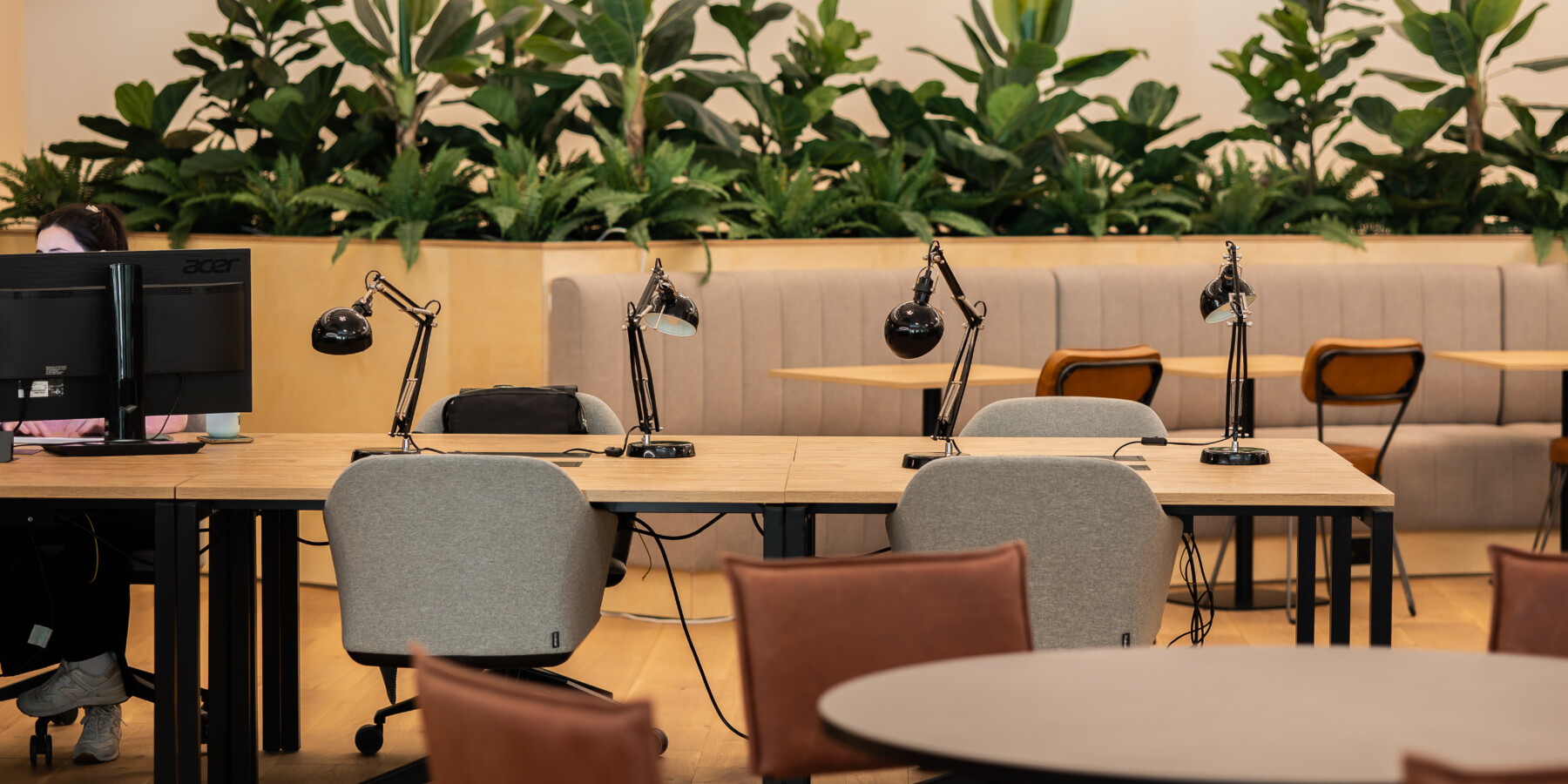
The Plant-Led Productivity Blueprint for UK Businesses
There is a persistent idea in office design that the environment is a backdrop. That what matters is the desk, the chair, the monitor, the functional infrastructure. Everything else is a luxury.
The evidence says otherwise. And for UK businesses dealing with the highest levels of sickness absence in a decade, mounting stress-related costs, and a workforce showing record signs of burnout, that evidence deserves a serious hearing.
This piece sets out what we actually know about plants, workspace design, and performance, then offers a practical framework for putting that knowledge to work.
9.4 days
Average UK sick days per employee/year — a decade high (CIPD 2025)
£102bn
Annual cost of poor mental health to UK employers (AXA, 2023)
+15%
Productivity in green offices vs. lean spaces (Cardiff/Exeter, 2014)
The Problem With Lean
For decades, a strand of management philosophy has insisted that clarity and minimalism drive performance. Clear desks, clean walls, standardised layouts. Remove the unnecessary; maximise the functional. It became the default logic of the modern corporate interior.
But lean office design was never particularly well-evidenced as an approach to knowledge work. It was a philosophy derived from manufacturing, applied, often without scrutiny, to environments where the outputs are ideas, decisions, relationships and analysis. And it turns out that knowledge workers are not components in a production process.
The Research:
In 2014, researchers from Cardiff University, the University of Exeter, the University of Groningen and the University of Queensland conducted the first major field study to test lean against green in real commercial offices. Across three experiments in large workplaces in the UK and the Netherlands, adding plants to a previously bare office increased productivity by 15%, alongside significant improvements in concentration, perceived air quality, and workplace satisfaction.
“Our research questions this widespread conviction that less is more. Sometimes less is just less.”
— Professor Alex Haslam
The study,published in the Journal of Experimental Psychology: Applied, is rigorous and frequently cited. Its finding is consistent with a much larger body of research that preceded and followed it.
The Evidence Base
The Exeter/Cardiff study is one data point in what is now a substantial body of research. The Human Spaces global report (Interface / Prof Sir Cary Cooper, 2015) surveyed 7,600 office workers across 16 countries to quantify the impact of biophilic design on workplace outcomes.
Measure
Findings — workers with natural elements vs. without
Wellbeing
+15% higher reported wellbeing
Productivity
+6% higher self-reported productivity
Creativity
+15% higher creativity levels
Design & hiring
33% say office design would affect their decision to join a company
Greenery gap
58% of global office workers have no live plants at work
Light gap
47% of global office workers have no natural light at work
A 2024 study in Scientific Reports, drawing on longitudinal data from over 600 white-collar office workers across two studies, found that indoor nature exposure increases employee wellbeing through improved ‘vigor’, energy, motivation and mental resilience. Crucially, this effect was not limited to people who consciously sought out nature: the environment itself lifted performance, regardless of individual disposition.
The UK Context: Why This Matters More Than Ever

The CIPD’s 2025 Health and Wellbeing at Work survey, the most comprehensive annual measure of its kind in the UK, found that average sickness absence has reached 9.4 days per employee per year. That is the highest figure in a decade, up from 5.8 days in 2022. Mental ill health is now the single biggest driver of long-term absence, cited by 41% of UK organisations. Stress-related absence affects 64% of workplaces.
The financial implications are stark. Analysis from AXA UK put the cost of poor mental health to UK employers at £102 billion annually. Research by Fair4All Finance estimated that reducing stress-related absence alone could add £5.9 billion to the national economy.
The Design Connection:
Workplace environment is not the only driver of wellbeing — but it is one of the few things decision-makers can actually control. You cannot legislate away personal pressures or economic anxiety. You can control whether the space people work in supports or undermines them. Biophilic design is one of the highest-evidence, lowest-risk interventions available at the level of the built environment.
It is also worth noting that a third of UK workers say office design would affect their decision to work for a company. As hybrid work embeds and organisations compete to make the return to office compelling, the physical environment has become a recruitment and retention factor, not just a productivity one.
Why Plants Work: Three Mechanisms
Understanding the mechanisms behind the evidence clarifies what actually drives the effect, and why some approaches are more effective than others.
1. Attention Restoration
Attention Restoration Theory (ART), developed by psychologists Rachel and Stephen Kaplan, proposes that natural environments restore depleted directed attention, the focused, effortful cognitive engagement required for most knowledge work. Natural stimuli engage what the Kaplans called ‘involuntary attention’: a softer mode of engagement that allows directed attention systems to recover. The implication: regular visual access to greenery, even passive, peripheral exposure, helps sustain concentration over longer working periods.
2. Stress Reduction and Physiological Regulation
The evidence that plants reduce physiological stress markers is well-established across multiple studies. Indoor plants are consistently associated with lower systolic blood pressure, reduced cortisol levels, and lower heart rate, all objective indicators of reduced stress load. The autonomic nervous system responds to natural environments in ways that shift it towards a more parasympathetic state. A workplace that maintains lower background stress is one where people perform more effectively for longer.
3. Work Engagement and Environmental Perception
The Exeter/Cardiff study found that plants increased employees’ work engagement, their physical, cognitive and emotional investment in their work. One mechanism is environmental quality perception: people in green offices reported feeling that the air was cleaner, the space was more pleasant, and the organisation cared about them. These perceptions translate directly into motivation and discretionary effort.
A Zoning Framework: Plants by Workspace Type
The highest returns come from thoughtful specification matched to the function of each area. The following framework covers the most common zones in modern UK offices.
Workspace Zone
Primary Need
Recommended Plants
Density Guide
Reception & Entrance
First impressions, brand signal
Statement trees (Ficus, Dracaena), green walls, large floor plants
High visual impact — one large specimen or a full green wall
Open-Plan Desking
Sustained concentration, noise reduction
Sansevieria, Pothos, mid-height divider planters
1 plant per 2–3 workstations; boundary planting between zones
Collaborative / Breakout
Creative thinking, interaction
Varied species, edible herb walls, hanging plants, bright foliage
Dense, sensory planting, stimulate rather than soothe
Focus / Deep Work Zones
Minimise distraction, restore attention
Boston Fern, Spider Plant, English Ivy as backdrop
Background green presence — visible but not the focal point
Meeting Rooms
Reduced stress, clear thinking
Compact plants on sill or table; moss or living wall feature
One feature plant per 8–10 sqm; avoid heavy flowering species
Corridors & Transition
Mental reset between tasks
Trailing plants, wall-mounted planters, green wall panels
Continuous presence encourages restorative micro-breaks
Welfare / Kitchen
Mood lift, community signal
Edible plants, herb walls, compact fruit trees
Functional and aesthetic, connects greenery to daily routine
Additional Zone
Add your primary need
Recommended plants
Density guidance
On Plant Density:
The research is consistent: more plants deliver more benefit, up to a point. The practical target is ensuring that no employee is entirely unable to see a plant from their workstation. Green walls in reception, breakout or circulation areas are the most efficient way to achieve high-impact coverage in a single installation — delivering the density that research associates with the strongest wellbeing and productivity effects.
Green Walls: From Feature to Infrastructure
The most efficient way to achieve meaningful plant coverage at a commercial scale is the living green wall. Rather than distributing dozens of individual potted plants, each requiring individual care, each covering a small area, a professionally installed green wall delivers concentrated plant mass, a rich root-zone environment, and a visual impact that changes the character of a space.
From an FM perspective, a maintained green wall is also simpler to manage than an equivalent number of individual plants. A professional maintenance contract covers the entire installation as a single line item, plant replacement, seasonal care, watering and fertilisation handled by specialists.
Green walls also serve structural functions: defining zones without solid partitions, absorbing sound in open-plan environments (both leaf mass and substrate layer contribute to acoustic dampening), and providing the density of greenery the research associates with the strongest effects.
On Plant Density:
A Great Place to Work survey of 2,200 UK employees found that employees with high levels of workplace wellbeing are three times more likely to stay with their employer, and three times more likely to go the extra mile. If a professionally installed green wall costs a fraction of a single senior hire’s recruitment fee, and the evidence indicates it contributes meaningfully to the conditions that reduce turnover, the ROI case is not difficult to make.
Standards Alignment: WELL, BREEAM, and Certification
For organisations pursuing formal building certifications, plant specification is not merely a design preference, it directly contributes to accreditation points.
The WELL Building Standard v2 includes a ‘Mind’ concept covering features that support mental health and cognitive performance. Biophilic design, incorporating indoor plants, living walls, and views of nature, is explicitly recognised as a feature strategy within WELL. Points are awarded for biophilic design plans that include plants within sightlines of regularly occupied spaces, and for interior gardens and living walls that meet specified coverage thresholds.
BREEAM, the UK’s most widely used sustainability rating system, includes credits relevant to indoor planting under its Health and Wellbeing and Ecology categories. Engaging a specialist interior landscaper at the design stage, rather than as an afterthought, ensures planting contributes to certification targets as well as occupant experience.
The Maintenance Imperative
Every benefit in this article depends on one condition: the plants must be healthy. A University of Reading and RHS study was unambiguous, unhealthy, neglected plants produce a negative effect on wellbeing. A brown, struggling plant signals neglect; a thriving one signals care.
Beyond the psychological dimension, the physiological mechanisms through which plants improve environments are contingent on plant health. Transpiration, VOC absorption and root-zone activity all reduce significantly in stressed or dehydrated plants. The Science requires the horticulture.
This is why professional maintenance is a structural requirement, not an optional extra. Urban Planters provides ongoing care contracts covering all installations, from individual plant schemes to complex living walls, ensuring that the benefits that justified the investment continue to be delivered.
The Straightforward Case
Workplace design has always influenced performance. What is different now is that we have precise, peer-reviewed evidence for specific interventions, and plants are among the most thoroughly studied.
A 15% productivity increase. Measurably lower stress. Higher wellbeing, greater creativity, stronger work engagement. An environment that people find more worth returning to. Reduced sickness absence. Improved recruitment signals.
Each outcome represents real commercial value. Together, they make a case that is not about aesthetics or wellness trends. It is about designing workplaces that allow the people inside them to function at their best — which is, in the end, exactly what every organisation needs from its environment.